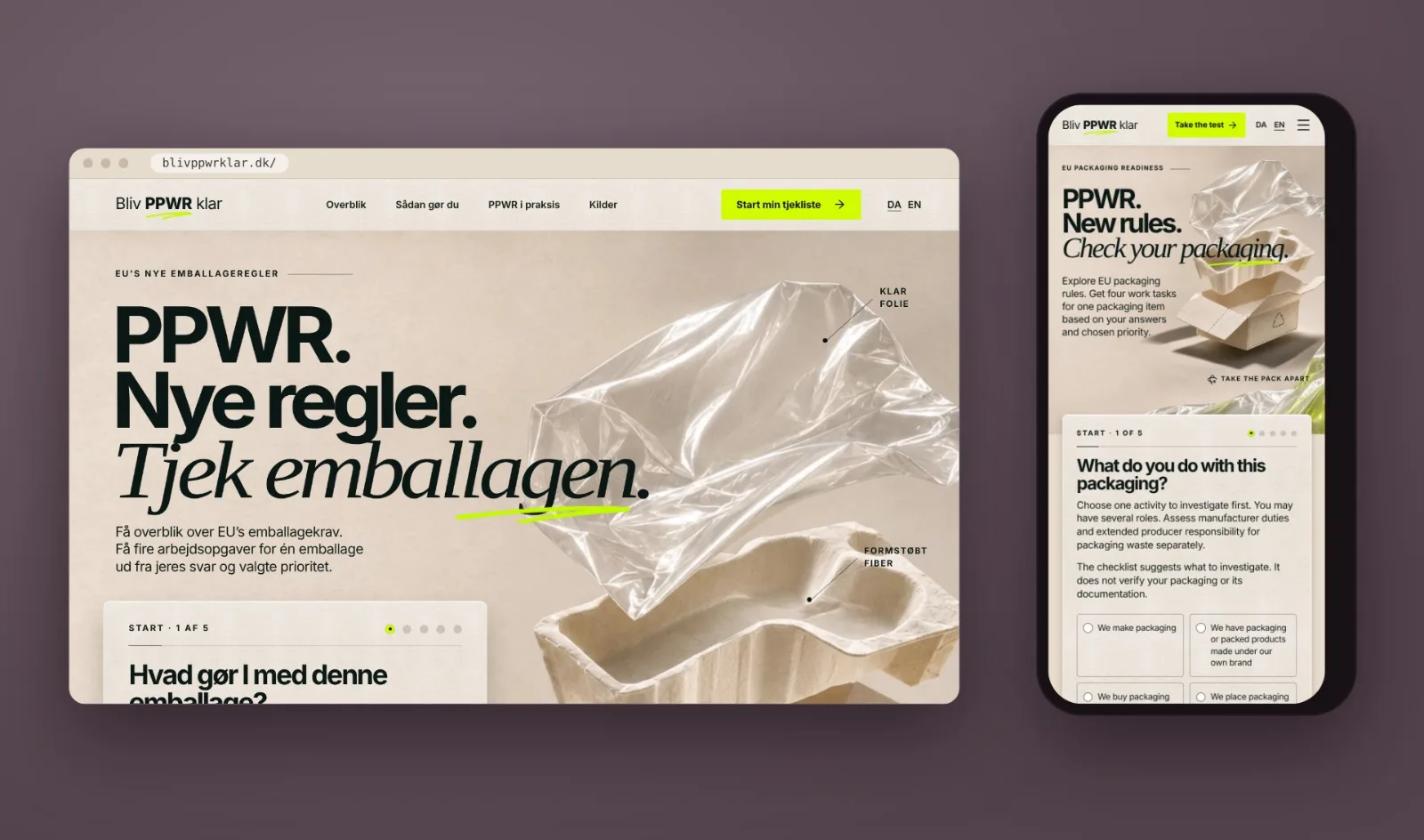
The EU’s new packaging regulation tells companies what applies. It does not tell them where to start. So I built the starting point: five questions about one pack, and four tasks to take back to the team.
- Concept, UX and interface design
- A five-step readiness test with tailored work tasks
- Source links to the articles and annexes of Regulation (EU) 2025/40
- An interactive “take the pack apart” model, drawn in plain canvas
- Complete Danish and English versions, each with its own URL
- A static build with prerendered SEO, Open Graph and structured data
- A built-in text editor that publishes straight to GitHub
Role: Lars Sohl . Concept, UX/UI & development · Work for www.Brandsurface.dk · 2026
The problem
PPWR is the Packaging and Packaging Waste Regulation, Regulation (EU) 2025/40. It has generally applied since 12 August 2026, and it reaches companies that make, import, distribute, fill or unpack packaging. Some requirements are already in force. Others arrive in 2028, 2030 and 2035.
What applies to you depends on your role, the pack, its material and the countries you sell in. The answers are spread across the regulation itself, the Commission’s guidance and national rules. In Denmark that means the Packaging Order and producer responsibility. A team has to work out which parts concern them before it can do anything useful.
Brandsurface designs packaging, so the need was close to home. Explaining PPWR was never the goal. Getting a team from “we should look at this” to a list of concrete next steps was.
The decisions
Start with one pack, not the whole regulation.
The site asks you to take one product off the shelf. Five questions follow: your role, where the pack is first made available, what it is made of, how complete your data is, and what you want to clarify first. The answers become four work tasks, with your chosen priority on top.
You can have several roles, so the test works on one pack at a time and is meant to be run again for the next one.
Keep advice and law apart.
Every item in the checklist is labelled either “Practical advice” or “Legal requirement”. A requirement always names where it comes from: a PPWR article or annex, the Commission’s guidance or the Danish Packaging Order, each one linked. It is easy to blur “this is a good idea” with “this is the law”. The labels keep them apart.
The same goes for what the test doesn’t know. Say you haven’t mapped your markets yet, and the requirements are no longer called “Legal requirement” but “Potential EU requirement pending confirmation of the market”.
Say what the tool can’t do.
The checklist suggests what to investigate. It does not verify a pack or its documentation, and it says so on the question screen and again on the result, not only in a footer. A readiness tool that overpromises is worse than none.
Ask about food contact, because it changes the answer.
The material question comes with a food-contact question. Answer yes, and the checklist adds the PFAS limits for food-contact packaging in Article 5(5), with a reminder to ask the supplier for evidence.
Take the pack apart.
A small model of a pack, with film, a moulded-fibre insert and a folding carton, that you can rotate and pull apart. Each layer comes with a question for the supplier: what does the film protect against, could a lighter insert do the same job, could the carton be smaller? They tie back to the packaging-minimisation rules (Article 10 and Annex IV), and one button copies the questions for your next supplier email.
The model is drawn by hand in a 2D canvas, about 7 KB, and only loads when you open it. If it can’t load, the page falls back to the photograph.
Private by construction.
The test needs no account. The script never sends your answers anywhere: it makes no fetch, XHR or beacon calls, and the only thing it loads on demand is the 3D model. Saving is optional. Choose “Save on this device” and the answers and ticks go to local storage for 30 days, with one button to delete them. The site sets no cookies, and every request goes to its own domain.
Two languages, done properly.
Danish lives at / and English at /en/. Both are prerendered at build time, each with its own title, description, canonical URL, hreflang links, Open Graph tags and structured data, and both are in the sitemap. Switch language in the middle of a test and your progress comes with you.
No CMS. One text file and a small editor.
The site’s texts, in both languages, live in one file. A built-in editor shows Danish and English side by side, keeps drafts in the browser and publishes by committing the change to the repository through the GitHub API. It needs a GitHub token from someone with admin rights to the repository, and the access is checked again on every operation. The copy can change without a developer, and there is no database to run, patch or back up.
What was built
A static site: one HTML page per language, one stylesheet, one script and a lazy-loaded model, hosted on Vercel. There is no framework and no web fonts. Images are WebP, with separate mobile crops. A small Node script prerenders the Danish and English pages from one template and the text file.
Result
A live, bilingual readiness check at blivppwrklar.dk. Measured with Lighthouse 13.6 on 20 November 2026: on desktop, Performance 100, Accessibility 100, Best Practices 96 and SEO 100; on mobile, Performance 95. During the full walkthrough in the video, the site made no request outside its own domain and set no cookies.
It is deliberately a starting point. It will not tell you whether a pack complies, and it says so. What it does is replace “where do we even begin” with four named tasks and a source to check for each.