The thesis: never mind, as long as it works
I’ve had several discussions with companies about how they view a future where AI is involved in the design process – in product development, in marketing, and in the customer experience itself. My thesis has been simple: the consumer of the future won’t care if something has been slightly polished by a machine. If the product is cheap, good and lasts for 100 years, then it’s irrelevant whether an image, a piece of text or a customer service conversation has been created by AI.
It’s not such a far-fetched idea. A source in the Danish clothing industry puts it bluntly: According to one industry player, customers don’t care whether something is AI-generated – what matters is whether the product is displayed properly online. In other words: it’s the result that counts, not the process.
But the data paints a more mixed picture
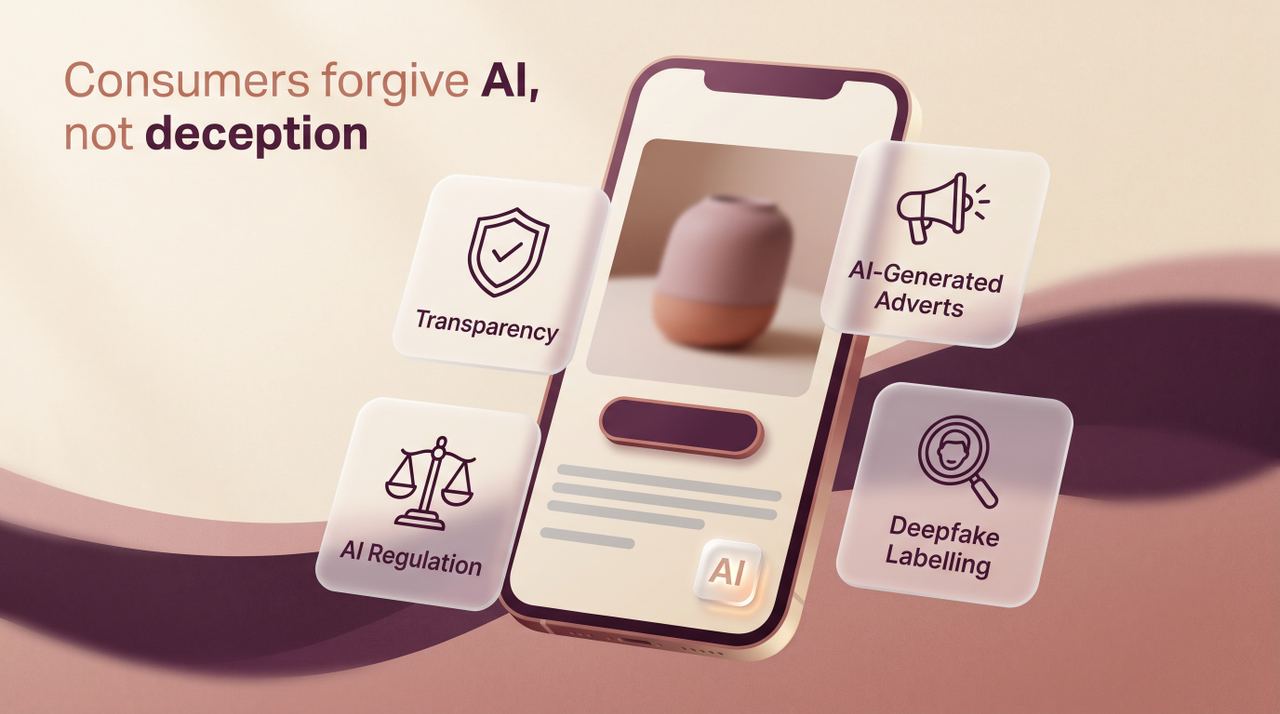
The problem is that when you ask consumers directly, you get a different answer to when you observe their behaviour. A survey by Norstat for Business Danmark of over a thousand Danes showed that 64 per cent of those surveyed believe that companies should state if their adverts have been created with the help of AI, and the proportion is even higher amongst young people under 35, where 74 per cent want AI-generated adverts to be labelled. This suggests that consumers like the outcome of AI, but still want to know that they are looking at it.
A researcher from Copenhagen Business School highlights a similar nuance: initial research suggests that consumers do not necessarily object to AI in adverts – as long as there is transparency. This is not the same as indifference. It is a conditional acceptance: feel free to use AI, but don’t lie about it.
Business Danmark has investigated a related question – can people even tell the difference between genuine and AI-generated content, and do they not care if they cannot? The conclusion is clear: the fact that most of us cannot tell the difference does not mean that we do not care. Scepticism and curiosity coexist within the same population.
Legislation makes the issue less academic
Regardless of where consumers’ views actually lie, the debate over ‘does it matter or not’ will soon become partly irrelevant for companies operating in the EU. From 2 August 2026, the transparency requirements set out in Article 50 of the AI Regulation will apply, and they have a broad scope – covering not only high-risk AI, but any business that uses a chatbot, publishes AI-generated articles or generates synthetic images, as outlined in a review of the rules, which states that [any organisation that builds or deploys generative AI systems that reach people in the EU will have a new legal obligation to disclose that the content has been generated by AI](https://www.bureauoversigten.dk/ articles/guides/ai-labelling-in-marketing-what-your-business-needs-to-know-before-august-2026). Deepfakes and realistic synthetic content must be clearly labelled, and it is not sufficient to include this information in the terms and conditions.
This means that ‘fake or real’ is not merely a philosophical question of consumer psychology. It becomes a compliance issue, with fines resulting from a failure to label such content. So even if the consumer is, in reality, indifferent, the company cannot afford to be.
What does this mean in practice for products and websites?
The interesting shift is not whether AI can be used – it can, on a large scale – but that transparency becomes part of the product, not an afterthought. The same logic applies when building websites and digital products using AI tools: an AI-built site that looks great is not the same as a site that is transparent about its own creation and can be found and understood by both people and search engines. I’ve written about this in relation to SEO, GEO and AEO in practice for AI-built websites.
So my thesis is only half true. Consumers probably don’t care about the process behind a good product – but they do care about being lied to about it. This is the distinction that businesses will need to navigate from August 2026 onwards, regardless of what they themselves believe about their customers’ indifference.
Conclusion
“Fake or real” will no longer be a question consumers stop asking. It will become a question the law asks of them – with labelling requirements, fines and a clear expectation that transparency is the norm, not the exception. A good product still beats everything else, but that does not exempt anyone from stating clearly how it came about.
By Lars Sohl, Founder of Klokly.app and working with AI, design and digital product development