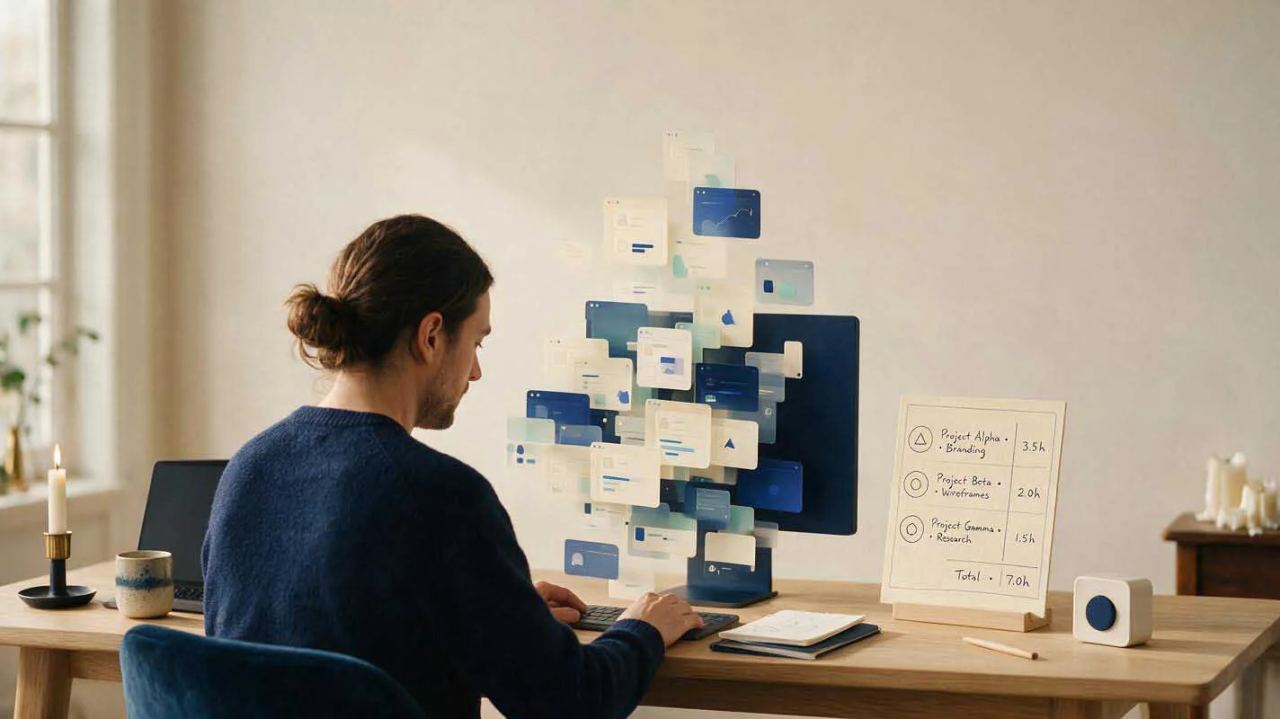
From Brushstrokes to Pixels
I've never liked the dividing line between "the creative" and "the developer". In practice, it's the same brain that composes an image in a camera and later writes the CSS to style that image on a website. The only difference is the tool. A brushstroke and a pixel are both decisions about where light and dark should sit — one is painted, the other is coded.
That's why I describe myself as an all-in-one creative: creative director, art director, graphic designer, photographer, videographer, advertising illustrator, designer and full-stack developer. Not because I'm the best at every discipline, but because I can see the entire chain from idea to living digital product. And that changes the way I design.
To me, graphic design, web design, programming, photography and digital development are much more closely connected than you might think. A good idea doesn't have to start in Photoshop or Figma. It can just as easily start with a pencil, a camera, a piece of code or a quick prototype in a browser.
Why "all-in-one" isn't a compromise
There's a common assumption that you'll become worse at everything if you try to do everything. My experience is actually the opposite, at least on smaller projects. When I photograph the material myself, I already know exactly how it needs to be cropped, compressed and lazy-loaded before I've even taken the picture. When I create the graphics myself, I design them with the formats and resolutions the frontend will need from the very beginning.
There is no handover from department to department, no "that's not what I meant" between designer and developer — because it's the same person making both decisions, often within the same workflow.
It also means I can keep things simple. I don't need to build a system that has to communicate with three other systems and three other people. I can go directly from sketch to working code, test it and change direction the same day.
That's particularly valuable when a project needs to move from an idea to a real website, WordPress solution, digital prototype or web application. I can think about the user experience, visual expression and technical foundation at the same time.
Bringing it to life
What I love most is the moment when something static becomes alive. A picture can be beautiful, but a picture that reacts to the mouse, a pixel grid that animates itself, or a collage that builds itself inside the browser — that's where it gets fun for me.
I draw or photograph something, and then I "bring it to life": JavaScript, canvas, a little WebGL if I'm in the mood, or simply a CSS transition that makes something breathe.
It's not technology for technology's sake. It's because I've always loved creating things with my hands, and code is simply the latest hand I've been given. You could compare it to moving from painting on canvas to painting with light — the same urge to shape something, just in a different medium.
This is also where web development becomes interesting to me. A website doesn't have to be just a collection of text, images and buttons. It can be a space, a story, a small interaction or a digital experiment. Technology becomes interesting when it gives design another dimension.
AI as another creative tool
Over the past few years, AI has naturally found its place in my creative workshop. I don't see artificial intelligence as a replacement for creativity, designers or developers, but as another tool for exploring ideas and moving more quickly from thought to prototype.
AI can be used to generate images, explore visual directions, write and test code, or help build an initial version of a digital solution. But the tool doesn't necessarily make the interesting decisions. It's still up to the human to know what works, what needs to be removed, and when an idea is worth developing further.
For me, the interesting part is the meeting between creativity and technology. When design, code, AI, photography and animation can be used freely across disciplines, the process becomes less linear and more experimental.
Playfulness as a method
I deliberately work in a playful way. That means allowing myself to build things that have no commercial purpose — a pixel experiment, a small generative collage generator, a funny hover effect that doesn't actually do anything useful but is simply nice to look at.
It's not a waste of time. It's where I discover the tricks and intuition that I later use in real projects for clients.
The personal part isn't about keeping the work secret. It's about doing it for myself first. The love of creating something from nothing — and seeing it become something that lives in a browser — is the driving force. Everything professional comes afterwards, as a natural extension of something I would have built anyway.
That's also how I learn new technologies. Of course, I read about how things work, but I understand them best when I build something with them. A small experiment can be enough to understand a new technique, a new tool or a new way of solving a problem.
In the end, it's therefore not so much about being a designer or a developer. It's about being curious enough to find out how an idea can become something you can actually see, use and play with.
Written by Lars Sohl, www.larssohl.dk