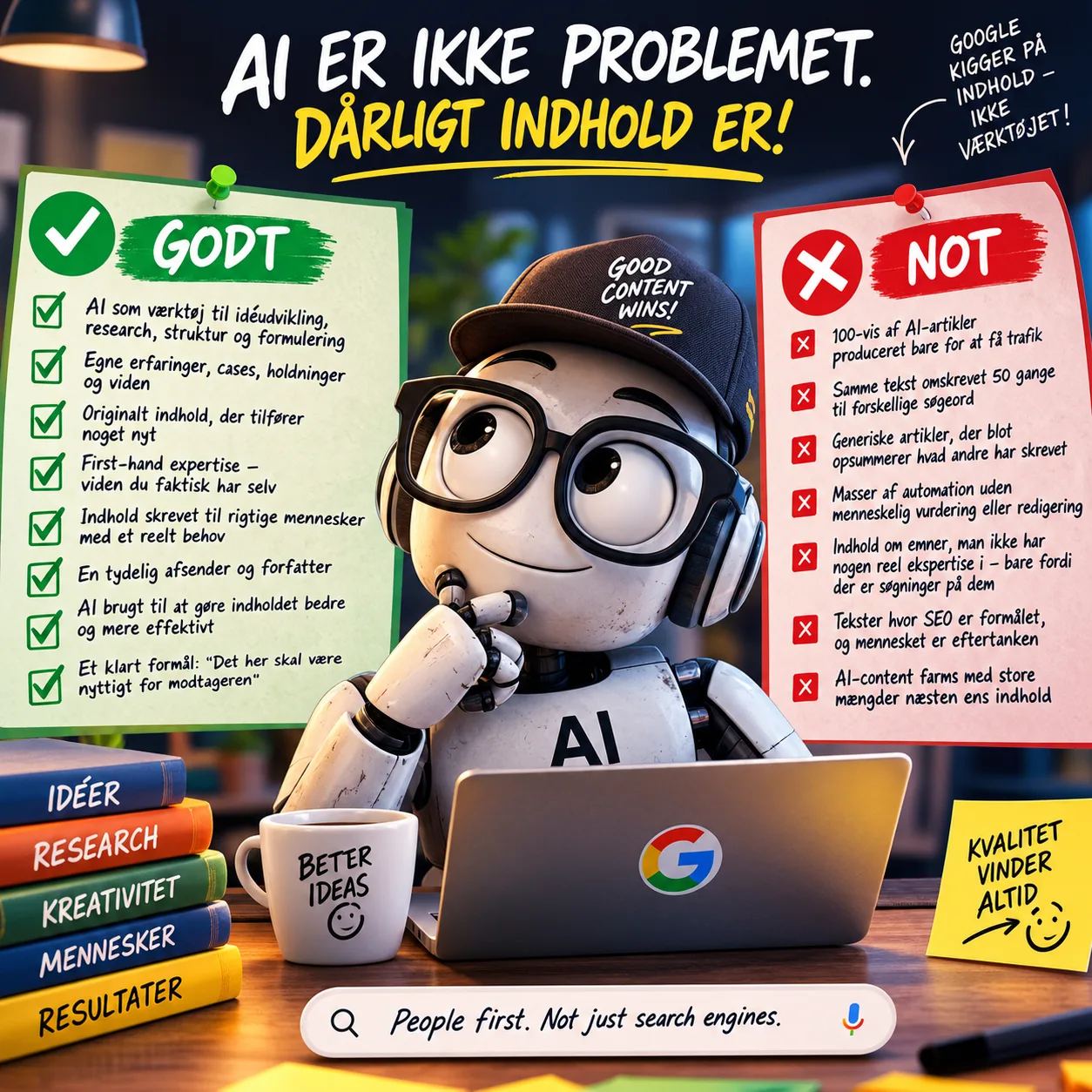
The Myth of the AI Penalty
There is a scare story circulating in marketing circles: use AI to write, and Google will send you to the basement. That story is an oversimplification to the point of being inaccurate. In Google's official guidance on AI-generated content, the Search Central team states quite directly that it is important to recognize that not all use of automation, including AI generation, is spam. Automation has long been used to generate helpful content, such as sports results, weather forecasts, and transcripts. AI has the ability to drive new levels of expression and creativity.
The crucial distinction lies not in the tool, but in the purpose. Google itself states: when it comes to automatically generated content, our guidance has been consistent for years. Using automation – including AI – to generate content with the primary purpose of manipulating rankings in search results is a violation of our spam policies. The point is therefore method-neutral: it is about intent, not the production method.
Scaled Content Abuse – What Google Is Actually Targeting
In March 2024, Google formalized a spam policy called "scaled content abuse", described in the update on the core update and new spam policies, which directly addresses mass-produced content. The definition is clear: scaled content abuse is when many pages are generated with the primary purpose of manipulating search rankings and not helping users. This applies regardless of who or what wrote the content – a human, AI, or a combination of the two.
That is precisely the practice described as "NOT" above: hundreds of articles produced solely for traffic, the same text rewritten for different keywords, content farms with almost identical content. It is not the AI that is being penalized – it is the pattern of volume without value.
Who, How, Why – Google's Own Checklist
Google has published specific self-assessment questions in its guide to creating helpful, people-first content, which are worth knowing if you want to assess your own content honestly. They recommend evaluating your content in terms of the "Who, How, and Why" as a way to stay on course with what our systems seek to reward.
- Who: something that helps people intuitively understand E-E-A-T in content is when it is clear who created it. That's the "Who" to consider.
- How: is it clear to the reader whether and how automation or AI was used, and why it was necessary?
- Why: was the page created to help people, or primarily to rank?
This ties directly into the E-E-A-T framework – Experience, Expertise, Authoritativeness, Trustworthiness – which Google uses to assess quality. Experience is the interesting addition from 2022: it is about whether the author has actually done what they are writing about. As Search Engine Journal summarizes in its overview of E-E-A-T, trust is the most important component because untrustworthy pages have low E-E-A-T, regardless of how experienced, expert, or authoritative they may seem.
What This Means in Practice
For those of us who work with AI as a creative tool rather than a factory, this is actually good news. We have previously written about how vibe coding is only half the job – an AI-built website that works technically is not the same as a website that can actually be found and provide value to a human. The same principle applies to content: AI can be an excellent sparring partner for structure, research, and phrasing, but it is no substitute for expertise and first-hand experience.
It also raises a question about transparency, which we have explored elsewhere: will consumers eventually stop caring whether something is AI-generated, as long as the product is good? The short answer is that labelling and authorship still matter – both for trust and, as is now clear, for Google's own evaluation criteria.
So the practical conclusion is simple: use AI to make your work faster, not to replace the knowledge you actually have. Write for a human with a real need, be clear about who is behind it, and let the purpose be usefulness – not volume.
Conclusion
Google has never said that AI content itself is the problem. They have stated this in black and white in their own guidance. The problem is content without value, regardless of who or what produced it. That nuance is worth holding on to the next time someone claims that AI and SEO are opposites.
Author: Lars Sohl, founder of Klokly.app and KodeKid