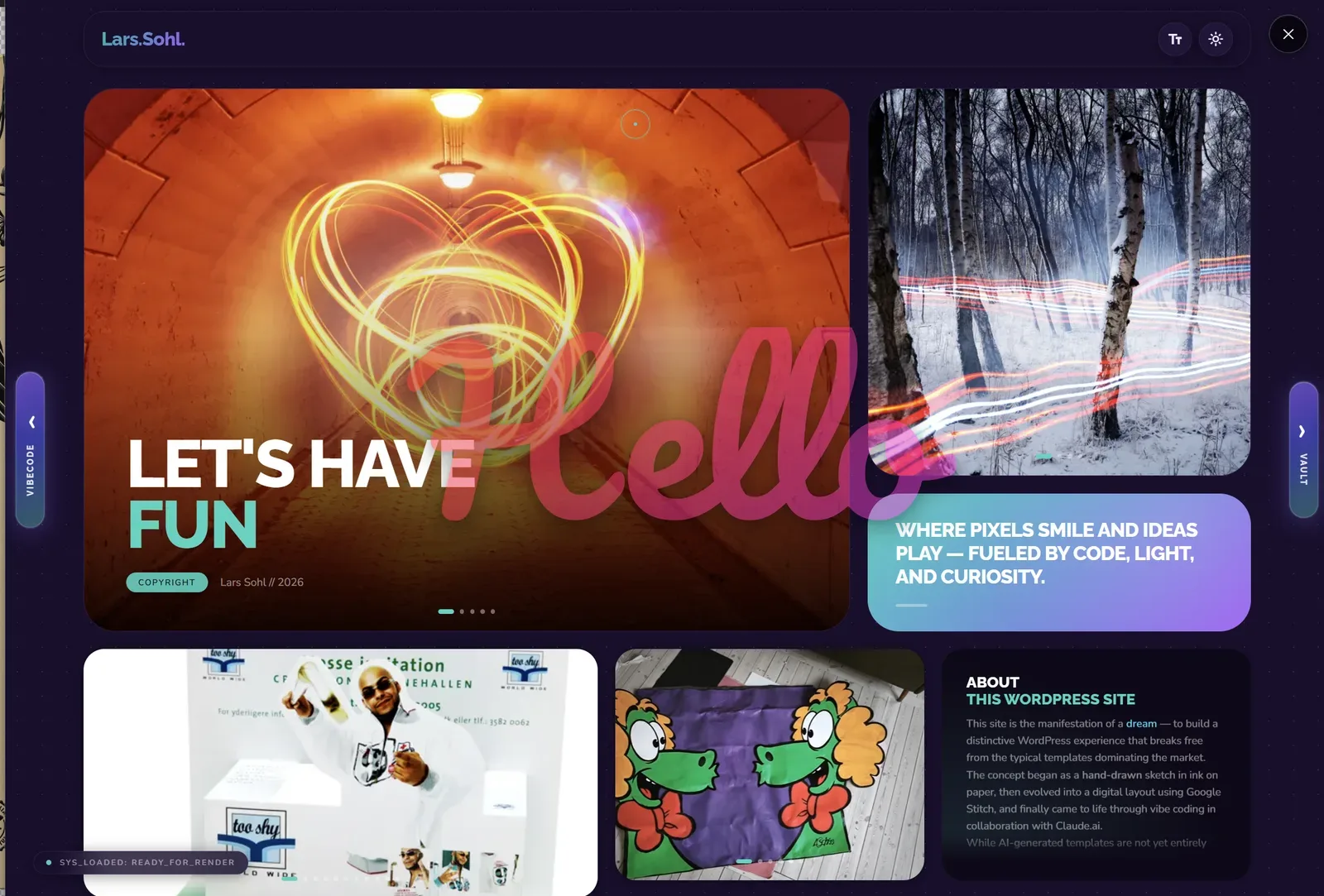
Role: Design, Development and Content · Own site · 2025
The problem
A standard theme decides what a WordPress site can be. Anything past what the theme anticipated turns into a hunt for plugins, and the site ends up shaped by its tooling rather than by its idea. I didn't want an off-the-shelf theme, and I didn't want to build another site that looks like ten thousand other WordPress sites.
The decisions
The site didn't start in WordPress. It started with a pencil and paper — the layout was sketched by hand before it became a digital design. From there, the choice was a genuinely custom theme with no parent/child structure to lean on: my own functions.php, my own template files, and my own ACF fields (Advanced Custom Fields) for exactly the content blocks the homepage needed — slideshow, CTAs, gallery. Claude was a pair-programming partner throughout, not a "generate me a website" button: each function was described, suggested, tested locally, and corrected when something looked wrong. That workflow still assumes you can read the PHP and the JavaScript yourself, or it's just guessing.
What was built
A theme and a backend written from scratch. Slideshows, text, CTAs, galleries and archives are all managed from a custom-built backend — alongside interactive elements, hidden functionality, a small built-in game, dynamic content, and experiments with AI, 3D, animation and web technology.
Result
Live at larssohl.dk — an example of WordPress used as a flexible framework rather than a CMS running a standard theme.