The production bottleneck nobody talks about
I've always cared more about the idea than the production. Not because production doesn't matter — it does. But when a good idea requires three days in After Effects, five rounds of keyframes, and a pile of manual tweaking, the production starts dictating which ideas you even allow yourself to have.
That's the specific problem I've been working on with KodeKid: a workflow where I can develop strong motion graphics far faster than a traditional production pipeline allows, while spending more time on idea, direction, and visual quality — not less.
This isn't about using AI as a shortcut. It's about treating AI, code, and creative development as one combined tool.
From art direction to animation, through code
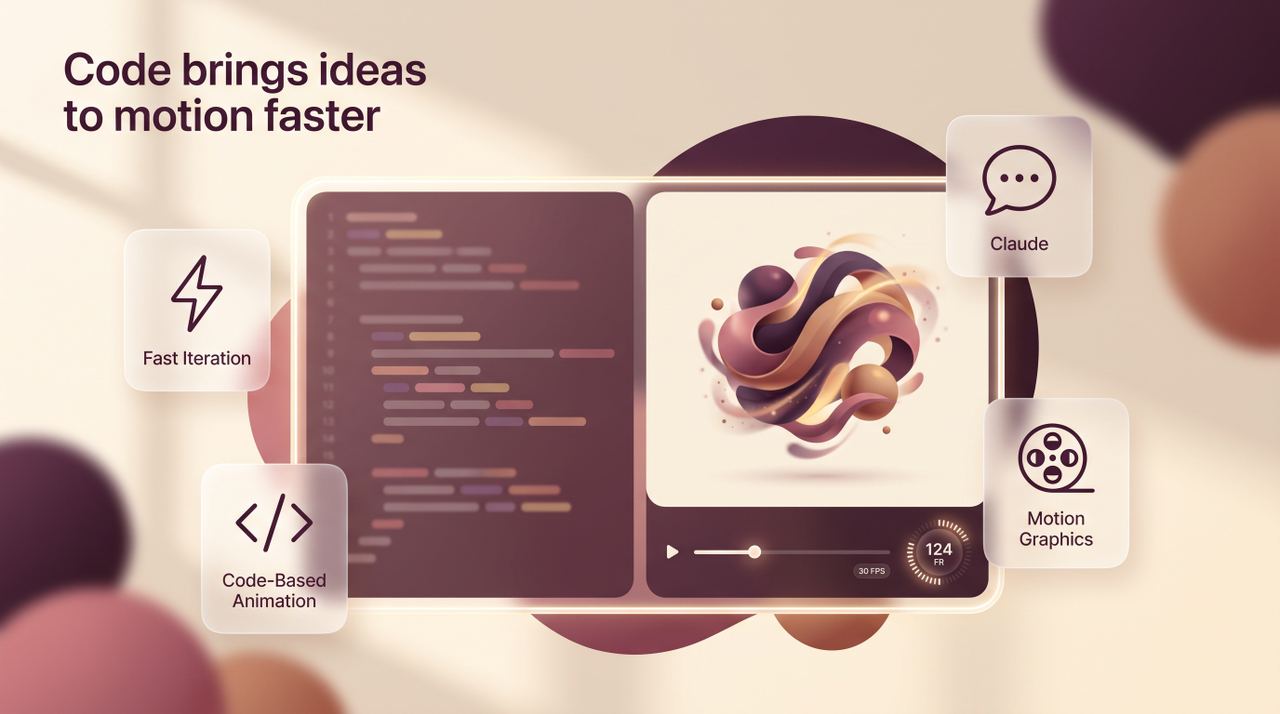
Traditional motion graphics work starts with: how do we animate this? My starting question is different: what would be interesting to see? From there, KodeKid becomes a production tool. With Claude, I can take a visual idea, describe it, discuss it, work out the animation's logic, and build a working version directly in code.
This is exactly the shift a growing number of motion designers are making right now. Instead of scrubbing a timeline, you write components, and instead of hand-placing keyframes, you drive motion with a frame variable and plain math — which is deterministic, version-controllable, and fully scriptable. That matters for iteration speed: if an animation doesn't work, I change it immediately, not the next day, not after a new production round.
It's worth saying this isn't new in principle. After Effects has had its own code layer for two decades — an expression is a small piece of JavaScript that lets you avoid creating tens or hundreds of keyframes by hand. What's changed is who can write that code, and how fast.
Claude as a creative-technical partner
Claude isn't a machine I ask to spit something out. I use it to think with — discussing timing, developing a transition, challenging an idea, and then writing the code that makes it all run. That lets me work much more directly between idea and execution, which I think is the actually interesting part of AI: not that it produces something for me, but that it lets me build and test things that previously required a much bigger production team or far more time.
One recent example of this comes from a public Claude Code skill built entirely around rendering motion design in pure code — HTML, a browser, and ffmpeg, no After Effects or paid rendering engine involved. The project's own launch video was made with Claude Opus 5.5 and this skill, in 5 iterations. Five iterations to a finished, beat-synced piece is a different production rhythm entirely from a traditional AE timeline.
I can afford to be more ambitious
When production gets cheaper and faster, it changes creative risk tolerance. I can try an idea that has maybe a 30% chance of working. I can build three different versions. I can go back, push the timing further, cut the obvious choice, and find the unexpected one. Motion stops being something you produce only after the concept is locked — it becomes part of the idea development itself.
This changes the role, not just the tool
I no longer work only between design and production. I move between concept, art direction, design, animation, code and AI in the same session — I can have an idea in the morning and a working motion prototype the same afternoon. That doesn't make me an animator in the classical sense. It makes me something I find more interesting: someone who can build what he imagines, the same philosophy I've written about in why I build everything myself and in how vibe coding changed my process more broadly, not just for motion.
The point isn't that AI can make motion graphics
It can. The interesting part is what happens when a creative person gets to go directly from idea to working result. It changes the speed, the economics, and the number of ideas worth exploring. Maybe most importantly, it changes the ambition level.
This isn't about automating motion graphics. It's about removing enough friction from production that there's room left for the thing that was always the most important part: a strong idea.
Author: Lars Sohl, founder of Klokly.app and KodeKid