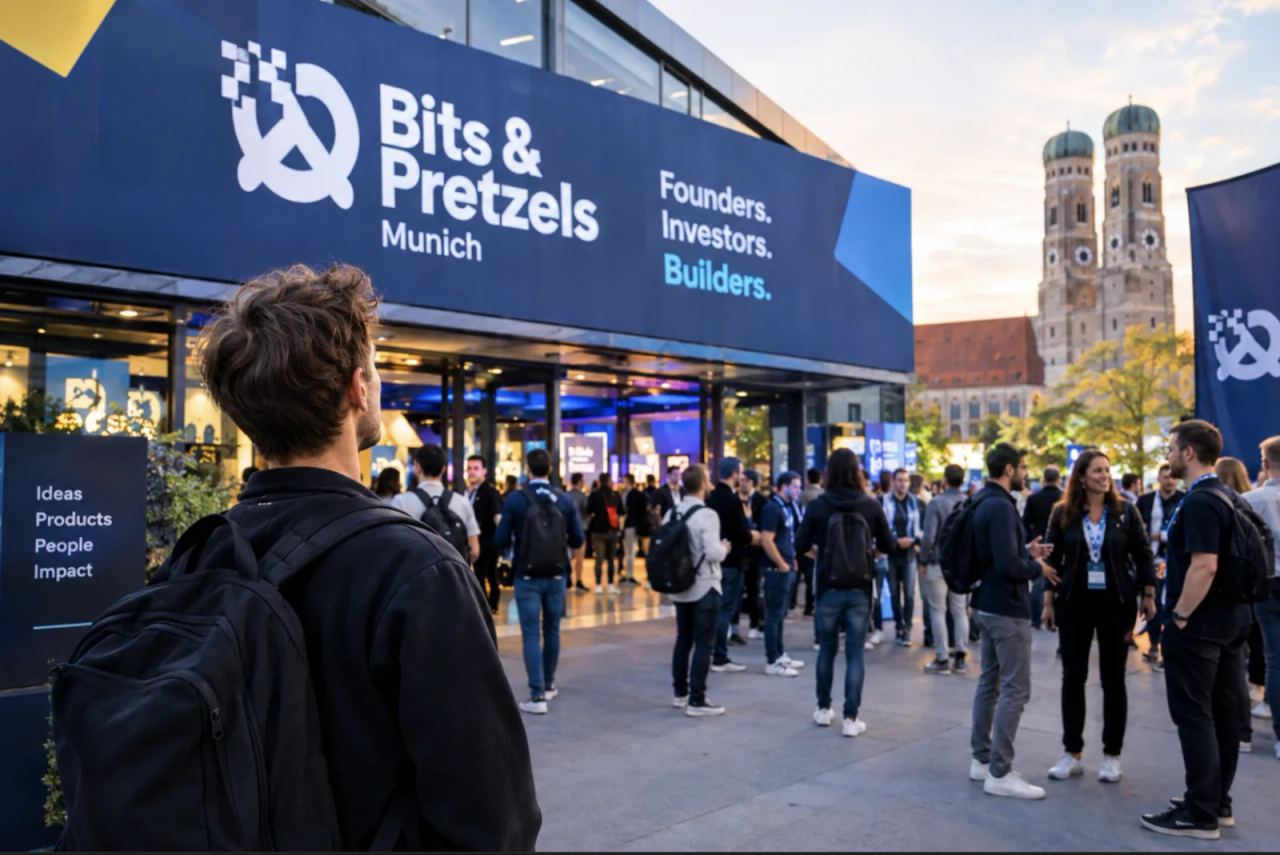
Bits & Pretzels 2026: Meeting the People Building the Future
30 September 2026
I went to Bits & Pretzels in Munich looking for interesting conversations, new ideas and people working on things that might shape what comes next.
I came home with all three.
More importantly, I came back with a stronger feeling that the future isn't built by technology alone. It is built by people who know how to connect ideas, design, technology, business and curiosity.
A room full of people building something
Bits & Pretzels brings together founders, investors, entrepreneurs and people working across the technology ecosystem.
This year's event took place in Munich from 28 to 30 September, bringing together people from startups, technology and business for conversations, meetings, talks and networking.
For me, the most interesting part wasn't sitting in a room listening to someone explain the future.
It was meeting people who were actually trying to build it.
From conversations to possibilities
I met founders working on hardware, AI, software, health, climate, food, robotics and completely new types of digital products.
Some were still developing their ideas.
Others already had products, customers, funding or international ambitions.
They were at very different stages, but there was a common thread.
They were all trying to turn something that currently exists as an idea into something people can actually use.
That is exactly the part I find interesting.
The gap between an idea and a real product
A product can start as a sketch on paper.
It can become a prototype, a landing page, a physical object, a mobile application or a completely new digital service.
But somewhere between the original idea and the finished product, a lot of things have to come together.
Design.
User experience.
Technology.
Code.
Brand.
Communication.
And increasingly, AI.
That intersection is where I like to work.
I've written more about this in Vibe coding is only the beginning, where I look at why AI-generated code is only one part of building a proper digital product.
Technology is getting easier. Ideas are not.
AI-assisted development has changed the speed at which software can be built.
I can take an idea and move surprisingly quickly from a thought to a working prototype. AI can help generate code, explore solutions, build interfaces, connect systems and solve technical problems while I build.
But it doesn't remove the difficult part.
Someone still has to decide what should actually be built.
What should the user experience feel like?
What problem are we solving?
What needs to happen behind the interface?
What should the product look like?
How should people understand it?
And what happens when the first version needs to become a real product?
That is why I don't see development, design and communication as separate worlds.
One person can connect more of the dots
This is also a big part of why I built KodeKid.
I wanted a place where I could work across design, UX, frontend development, backend development, AI-assisted coding and the wider technical side of a digital product.
It isn't a new idea for me.
I've always moved between creative and technical disciplines. I wrote about that in Playful with pixels: why I build it all myself, where I explore why I don't see the line between creative work and development as particularly useful.
Sometimes that means building a complete web application.
Sometimes it means creating a prototype.
Sometimes it means improving an existing interface or digital product.
And sometimes the first step is simply a conversation about whether an idea could exist.
The ability to move between the visual and technical sides of a project can make that process much faster.
You can see an idea.
You can design it.
You can build it.
Then you can change it again five minutes later.
That loop is becoming incredibly powerful.
Building means getting your hands dirty
One thing I noticed while talking to founders in Munich was how different every project looks once you get below the pitch.
A clean presentation might describe a simple product.
Behind it there can be databases, APIs, authentication, physical hardware, logistics, user flows, prototypes, websites and a hundred small decisions nobody sees.
That is where I tend to get interested.
I like finding out how the thing actually works.
For example, I recently documented how I used AI to build a custom WordPress theme and a standalone plugin with a phone-based interface, authentication and live status updates. How I Built a Custom WordPress Website with AI goes into the technical side of that process.
The technology is interesting.
But the more interesting part is how quickly an idea can move when design and development happen together.
The people are the interesting part
One of my biggest takeaways from Bits & Pretzels was how much can happen when the right people meet.
A developer can meet a founder with a problem worth solving.
A designer can meet a company with a product that needs a better interface.
A hardware startup can meet someone who understands how to bring the product to market.
A founder can discover a completely different way of thinking about an idea that has been stuck for months.
Not every conversation becomes a project.
That isn't the point.
The value is discovering where the pieces might fit together.
Building the future is a team sport
There is a tendency to talk about future products as if they appear fully formed from technology.
In reality, products are built through a chain of decisions made by many different people.
Someone has the original idea.
Someone challenges it.
Someone designs it.
Someone builds it.
Someone tests it.
Someone figures out how to sell it.
Someone makes people understand why it should exist in the first place.
The interesting projects happen when those disciplines stop behaving like separate islands.
And that was perhaps one of the strongest things I noticed in Munich.
There are a lot of smart people working on difficult problems.
But there are also a lot of opportunities for these different worlds to connect.
What I brought home from Munich
I travelled to Bits & Pretzels looking for interesting people.
I found founders with ambitious ideas, people working on technologies I hadn't seen before, potential collaborators and conversations that will probably continue long after the conference is over.
I also came home with a clearer picture of the kind of work I want to keep doing.
Taking ideas and making them tangible.
Sometimes that means code.
Sometimes it means design.
Sometimes it means AI.
Sometimes it means all three at once.
From Munich to the next prototype
The best conferences don't really end when everyone leaves the building.
The interesting part starts afterwards.
New conversations become prototypes.
Prototypes become products.
Products become companies.
And somewhere in that chain, two people who met for ten minutes in Munich might end up building something neither of them could have built alone.
That's probably my favourite thing about events like Bits & Pretzels.
You don't know what the conversation you're having today might become tomorrow.
Want to build something?
I work with founders and companies on digital products, web applications, prototypes, interfaces and the technology around them.
You can see the kinds of digital solutions I work with on the KodeKid services page, or explore more of the thinking and experiments in the KodeKid Guides.
If you're building something new and need someone who can move between idea, design and code, let's talk.
Frequently asked questions
What is Bits & Pretzels?
Bits & Pretzels is a founders festival in Munich that brings together founders, investors, entrepreneurs and industry leaders for networking, talks, meetings and business opportunities.
When was Bits & Pretzels 2026?
Bits & Pretzels 2026 took place from 28 to 30 September 2026 in Munich, Germany.
Why did I attend Bits & Pretzels?
I attended to meet founders, entrepreneurs and other people working with technology, business, design and new products, and to explore potential collaborations.
What did I learn at Bits & Pretzels?
One of my main takeaways was that great products are rarely created by technology alone. They emerge when different disciplines, ideas and people come together.
What does KodeKid do?
KodeKid works with digital solutions including web applications, software, interfaces, AI-assisted development, WordPress solutions and digital products.
Can KodeKid help turn an idea into a product?
Yes. KodeKid can work across design, user experience, frontend development, backend development, AI-assisted development and technical implementation to help turn an idea into a working digital product.